AI Automation Architectures for Bootstrapped SaaS: Open-Source Patterns to Match Enterprise Scale
Bootstrapped SaaS teams can deploy open-source AI architectures—data, orchestration, agent layers—to automate marketing, support, and ops at $100/month, matching VC-scale efficiency. Detailed patterns include RAG workflows, CrewAI orchestration, and safety gates with tradeoffs in latency and cost. CTOs gain concrete implementations to reduce solo ops overhead.

AI Automation Architectures for Bootstrapped SaaS: Open-Source Patterns to Match Enterprise Scale
Executive Summary
Bootstrapped startups face resource constraints that limit manual operations in marketing, customer support, and core workflows, while VC-funded rivals deploy capital-intensive AI systems. This article details open-source architectural patterns—data layers, orchestration, and agent execution—that enable solopreneurs to build AI-native automation matching enterprise efficiency at under $100/month in cloud costs.

These patterns shift SaaS from application-centric to AI-enabled platforms, using robust APIs, real-time data access, and workflow coordination to automate cross-system tasks. CTOs and technical founders at pre-seed to Series A stages should prioritize them to reduce operational overhead without vendor lock-in or large teams.
Targeted at technical leaders familiar with cloud-native stacks, the focus is on implementation logic: component interactions, integration points, and tradeoffs in cost, latency, and reliability.
Why Bootstrapped SaaS Needs AI-Native Architecture Now
Traditional SaaS architectures center on stateless CRUD operations against relational databases, handling approximately 10,000 transactions per second (TPS) in high-scale scenarios. Agentic AI demands conversation-centered designs that maintain state, process multimodal inputs, and scale to 1M TPS as agents interact continuously.
For bootstrapped teams, this means evolving from manual dashboards to AI orchestration layers that coordinate agents across marketing (lead scoring), support (ticket resolution), and operations (inventory sync). Economic pressures amplify urgency: VC rivals automate at scale via proprietary stacks, while solopreneurs must use open-source to avoid $10k+/month inference bills.
Key implication: Without API-first designs and event-driven orchestration, startups remain siloed, unable to integrate with emerging app/AI ecosystems where agents act as system connectors.
Core Architecture Pattern: Three-Layer AI-Native Stack
AI-native SaaS for low-cost automation builds on three layers: data aggregation, AI orchestration, and agent execution. This modular pattern supports real-time access, autonomous operation, and contextual intelligence without heavy infrastructure.
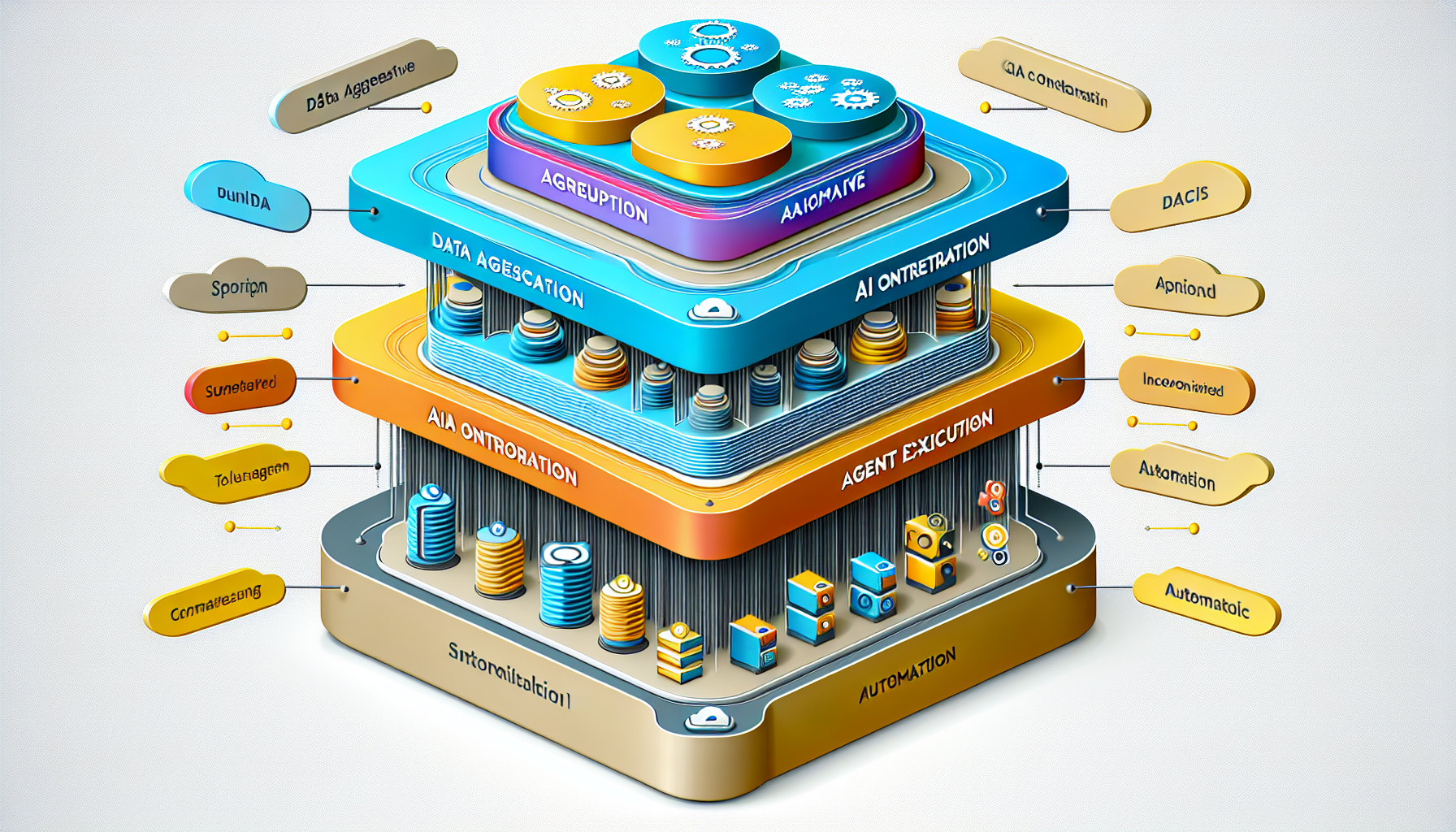
Data Layer: Unified Access for Agents
The data layer aggregates from CRM, email, and analytics tools into a vector store or lakehouse for efficient retrieval. Use open-source Apache Superset or ClickHouse on a $10/month VPS for querying; embed documents with Sentence Transformers (Hugging Face) for RAG (retrieval-augmented generation).
Workflow example: Marketing automation pulls leads from PostgreSQL, enriches with email opens from Resend API, and vectors for semantic search. Agents query via FAISS index (in-memory similarity search) in less than 100ms latency.
Implementation: Ingest via Apache Airflow DAGs on GitHub Actions (free tier). Tradeoff: Batch ingestion suits fewer than 1,000 daily events; real-time needs Kafka streams, adding 20% complexity but enabling live lead scoring.
Orchestration Layer: Coordinating Agent Workflows
This layer sequences reasoning, planning, and execution, transforming isolated apps into operational hubs. Open-source CrewAI or Autogen (Microsoft) handles multi-agent loops: planner decomposes tasks, tools execute, memory persists context.
Real-world scenario: Customer support agent for a solo SaaS founder. Incoming ticket → orchestrator routes to RAG retriever (data layer) → reasoning LLM generates response → validation gate checks policy (e.g., no PII leaks) → Zendesk API update.
Security: Policy engine (e.g., LangChain Guardrails) scans outputs; sandbox execution via Docker containers on Fly.io ($5/month). Monitoring: Prometheus + Grafana for latency SLOs (less than 2 seconds p95).
Agent Execution Layer: Task-Specific Automation
Specialized agents perform actions: marketing (content generation), support (query resolution), ops (syncs). Use local LLMs like Llama 3 via Ollama (zero inference cost) or quantized Grok API ($0.10/1M tokens).
Pattern: User goal → planner (e.g., 'Score 100 leads') → tools (SQL query, embed, rank) → executor (email nurture via Resend) → audit log. Multimodal extension: Process IoT metrics or screenshots with LlamaVision.
Tradeoffs:
| Option | Cost/Month | Latency | Reliability | Skills Needed |
|---|---|---|---|---|
| Local Ollama | $0 | 500ms-2s | Medium (drift) | DevOps |
| Grok API | $20 | 200ms | High | Low |
| OpenAI GPT-4o-mini | $50 | 100ms | High | None |
Local setups avoid vendor lock-in but require GPU VPS ($20/month on RunPod).
Case Study: Solo SaaS Founder's Support + Marketing Automation
Context: Anonymized solopreneur building a no-code analytics tool (MRR $5k, 200 users). Constraints: 10 hours/week ops time, $200/month budget. Goals: Automate 80% tier-1 support, nurture leads without hires.
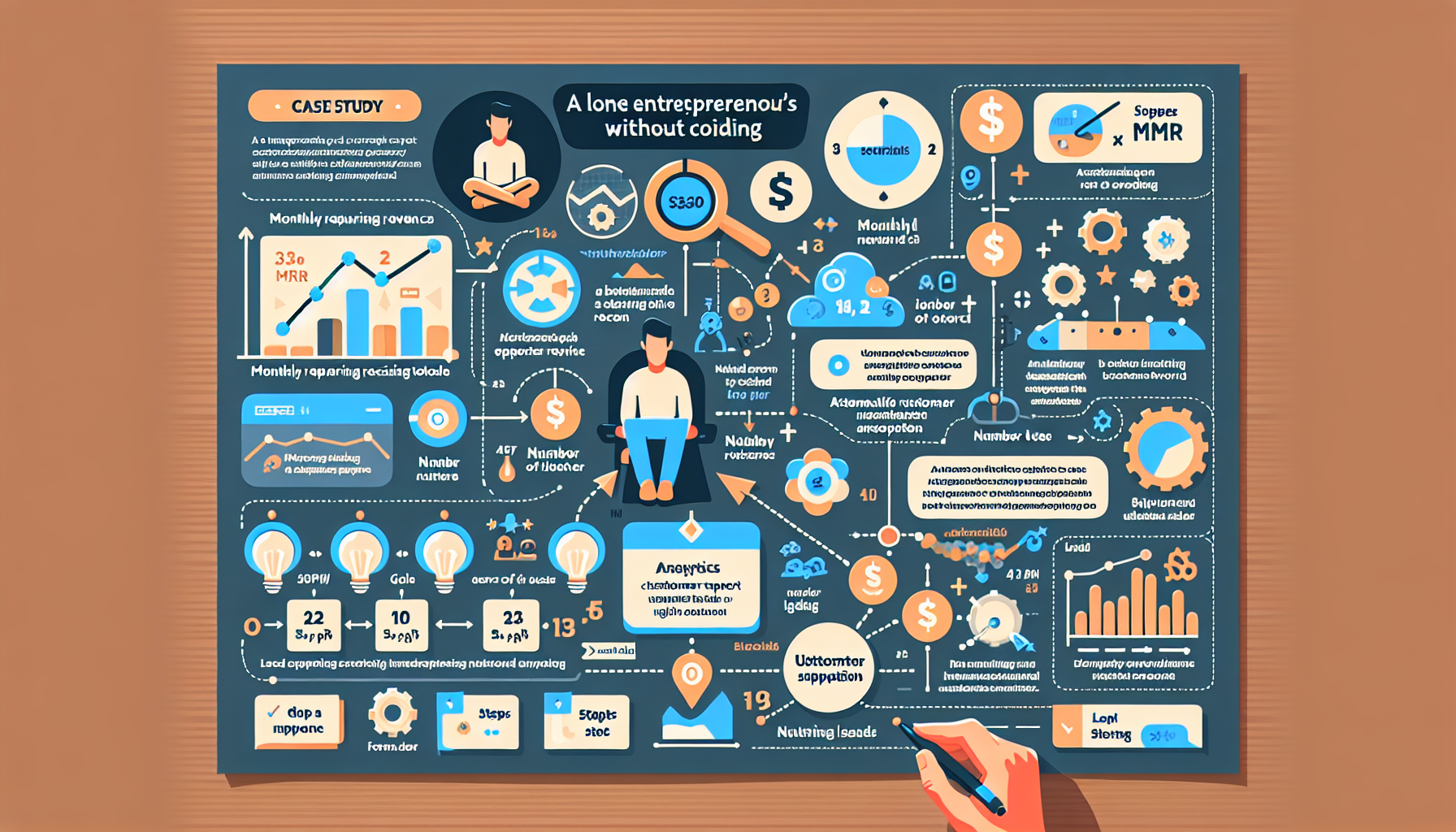
Stack: Fly.io ($15), Superset + FAISS (data), CrewAI (orchestrator), Ollama/Llama3 (agents), Resend/Zendesk APIs. No Kubernetes—single Docker Compose.
Workflow:
Failure mode: Early version hallucinated bad SQL, corrupting lead data. Detection: Post-execution diff validation (compare agent SQL vs. known query). Mitigation: Rollback via event sourcing (replay from log); added unit tests in orchestrator. Changed to hybrid local+API for critical paths.
Outcome: Support resolution from 2 hours/manual to less than 5 minutes/auto; marketing converted 2x leads via personalized sequences (directional from 3-month internal tracking). Ops time halved.
Lessons: Copy event-driven ingestion + validation gates. Avoid: Skipping sandbox (security holes); over-relying on one model (drift).
Practical Implementation: Agent Orchestration Pseudo-Code
Deploy this core loop for marketing automation. Assumes Python/FastAPI on Fly.io.
app.py: Marketing Agent Orchestrator
import crewai
from langchain_community.vectorstores import FAISS
from langchain_ollama import OllamaLLMComponents
llm = OllamaLLM(model="llama3")  # Local, $0
vectorstore = FAISS.load_local("leads_index")  # Data layerSafety: Policy + Sandbox
class PolicyGuard:
    def check(self, action: str) -> bool:
        return "delete" not in action and len(action) < 1000  # Example rulesAgent Loop
async def handle_lead_nurture(lead_data: dict):
    planner = crewai.Task(description="Plan nurture for lead: {lead_data}")
    retriever_task = crewai.Task(description="Retrieve similar leads", tools=[vectorstore.as_tool()])
    executor_task = crewai.Task(description="Generate email", agent=crewai.Agent(tools=[resend_api_tool()]))

    workflow = crewai.Crew(tasks=[planner, retriever_task, executor_task], llm=llm)

    plan = workflow.kickoff()
    if PolicyGuard().check(plan):
        # Sandbox: Run in Docker subprocess
        result = execute_sandboxed(plan)
        if validate_diff(result):  # Custom validator
            await event_bus.publish("nurture_sent", result)  # Downstream
    else:
        await slack_alert("Blocked: " + plan)FastAPI endpoint
@app.post("/leads/{id}/nurture")
async def nurture(id: str):
    lead = await db.get(id)
    await handle_lead_nurture(lead)
Rollout plan:
Flow text: Zendesk → API Gateway → Orchestrator → LLM Planner → Policy → Sandbox Executor → Validator → Event Bus → Resend/DB.
Challenges and Constraints
Technical: Context length limits (8k-128k tokens) cap complex ops; mitigate with RAG summaries. Throughput: Local LLMs bottleneck at 10 req/min; scale horizontally on $20 GPU. Data quality: Garbage KB yields bad RAG—clean via periodic Airflow jobs.
Cost: Inference dominates ($0.0001/token local vs. $0.01 API); egress from vector stores adds 20%. Observability: Loki logs free, but human review scales poorly.
Organizational: Solos lack ML skills—start with no-code like Flowise before code. Security: API keys expose risks; use Vault + RBAC. Compliance: Audit logs essential for GDPR.
Risks: Model drift (weekly eval needed); overdependence (multi-LLM fallback); shadow IT (enforce via IaC). Leadership expectations: Demo prototypes early to align on directional gains.
Actionable Takeaways
with webhooks; gap = manual drag.
FAQ
What are AI-native architectures for bootstrapped SaaS?
AI-native architectures for bootstrapped SaaS involve using open-source patterns to build automation systems that match enterprise efficiency without high costs. These architectures focus on data layers, orchestration, and agent execution to enable startups to automate tasks across marketing, support, and operations using AI.
How can bootstrapped startups use AI to automate their operations?
Bootstrapped startups can use AI to automate operations by implementing a three-layer AI-native stack. This includes a data layer for unified access, an orchestration layer for coordinating workflows, and an agent execution layer for task-specific automation, all using open-source tools to keep costs low.
What is the benefit of using open-source AI tools for startups?
Using open-source AI tools allows startups to avoid vendor lock-in and reduce costs significantly. These tools enable startups to build scalable AI-native automation systems for under $100/month, allowing them to compete with larger, VC-funded rivals without incurring high infrastructure expenses.
How do AI orchestration layers work in SaaS architectures?
AI orchestration layers in SaaS architectures sequence reasoning, planning, and execution tasks to transform isolated applications into interconnected operational hubs. They use tools like CrewAI or Autogen to manage multi-agent workflows, ensuring efficient task decomposition and execution.
What are the challenges of implementing AI-native architectures in startups?
Implementing AI-native architectures in startups can present challenges such as managing the complexity of real-time data ingestion and ensuring security through sandbox execution. Startups need to balance cost, latency, and reliability while integrating various open-source tools and maintaining effective monitoring and validation systems.
Related reading
Maksym Tytarenko
AI & SaaS Development Expert at Tytarenko AI Agency
Related Articles
Why I Rejected an 817-Skill Security Pack and Wrote a 2-File Threat-Model Skill
Someone shared a repository of 817 ready-made cybersecurity skills for coding agents. Instead of installing it, I read it, found it thin exactly where my products live, and wrote my own two-file threat-model skill around the one idea no checklist covers: abuse economics — how a product's own logic pays an attacker.
5 min readAI & MLI Turned a Telegram Group Into a Software Project
One private Telegram group = one project: an idea interview in chat, gated task cards for an agent fleet, command-only deploys, and APKs delivered as files. Built and shipped in a single working session.
10 min readAI & MLContext Engineering for Vibe Coding: Structured Prompts for Rapid SaaS Prototyping
Context engineering structures the full data environment for LLMs in vibe coding, turning vague ideas into reliable SaaS prototypes. This 2026 discipline reduces errors via retrieval, memory, and policies, ideal for scaling AI-assisted development. CTOs gain workflows and tradeoffs for immediate productivity gains.
6 min readReady to Build Your AI-Powered Solution?
Let's discuss how we can help you leverage AI to transform your business.
Get in Touch